A brief overview of the work that’s gone into the creation of this site and everything it contains, including the steps taken and the people involved. Read on for details of the questions we were holding, who was in the room, and some of the learnings along the way.
Our route into this inquiry was via the term ‘deep narrative’ – the stories that lie underneath the surface of our awareness, influencing how we think and act. Over time we started to wonder whether that language was slightly misleading. What we’re pointing towards is more like an orientation than a story: an underlying, largely unconscious assumption about who we are, our relationships to each other and with the rest of life. For now we’re finding ‘deep disposition’ a more useful working term, though the vocabulary is still settling. You’ll see ‘deep narrative’ in the names of the earlier steps below, because that was the language we were using at the time.
Context
Climate breakdown, genocide, rising fascism, inequality, ecosystem collapse… The stakes are high. Frightening futures are becoming increasingly probable — the success of the work of change-makers, both individually and collectively, has never been so vital.
Holding this, we have been attempting to work out what it might take to foster a degree of mutually-beneficial cross-issue strategic cohesion, to present a suitable and viable response to the powers and challenges of this moment.
Central to this has been the recognition that the almighty challenges we’re facing are symptoms of the systems we live in, and that these systems are shaped by, and in turn shape, deep dispositions — an undercurrent of tacit assumption about who we are in the world.
The dominant deep dispositions our societies are based on are giving permission and encouragement to systems that are destroying life. Our hypothesis is that if humanity wants a fair, liveable future on the planet, we need to reorient those dominant deep dispositions, towards ones that serve life. Doing so will take all we’ve got, and will push us beyond much of our traditional change-making practices, at least those familiar to the Global North/West.
Steps
Step 1 · Deep Narrative Dive
One-day workshop, funded by European Climate Foundation, Summer 2024
In summer 2024, with funding from the European Climate Foundation, The Culture Initiative hosted a one-day workshop that brought together 25 practitioners and funders working across the narrative and culture change field. We wanted to explore whether there was appetite for greater collaboration around deeper, cross-issue narrative work, and to pool what the field already knew about doing it. It was explicitly not an attempt to devise a single deep narrative that would work across all movements.
Questions
- Is there appetite within the narrative change field for this work?
- What does the field already know about doing this work?
Learnings
- Clear demand for deeper narrative work that can work across movements and issues.
- Not starting from scratch; plenty to learn from and work with, both in terms of precedents and narrative insight.
- Span movements, funders and sectors.
- Keep asking “who’s not in the room?”, and center diverse lived experience in our work.
- ‘Routes to audience’ are fundamental and need to be valued as such, both in terms of resource and strategy.
- Coordination and collaboration with the ground-level is key.
- Work for both the immediate and long-term simultaneously.
Hosts — The Culture Initiative
Attendees — practitioners from: HEARD, NEON, Telltale Research, Climate Outreach, Frameworks UK, Common Cause Foundation, Healing Justice LDN, AKO Impact Storytelling, Global Optimism, Act Climate Labs, Count Us In, Creatives 4 Climate, Climate Coalition, Reframing Race, Global Dialogue.
Attendees — funders from: ECF, Civic Power Fund, The JJ Charitable Trust / Climate Change Collaboration, JRF, Lankelly Chase, Calouste Gulbenkian Foundation UK branch.
Step 2 · Deep Narrative Development
Ongoing development, ECF funded, 2024–2025
Following the initial workshop, the next phase explored what a more coordinated programme of deep narrative work might look like. Ella Saltmarshe and Paddy Loughman, from The Culture Initiative, developed a range of early programme options, testing and developing them in conversation with movement leaders, experts and funders, including the advisers listed below.
Question — What could a blueprint for this work look like?
Early strategy thinking (2024–2025)
These two diagrams capture our early strategy thinking, before the inquiry got to where it is now. The first uses the Three Horizons model: horizon 1 is the dominant way of doing things now, horizon 3 the future we’re reaching for, and horizon 2 the transitional work in between. ‘Horizon 2+’ means transitional work that opens space for horizon 3, rather than propping up horizon 1.
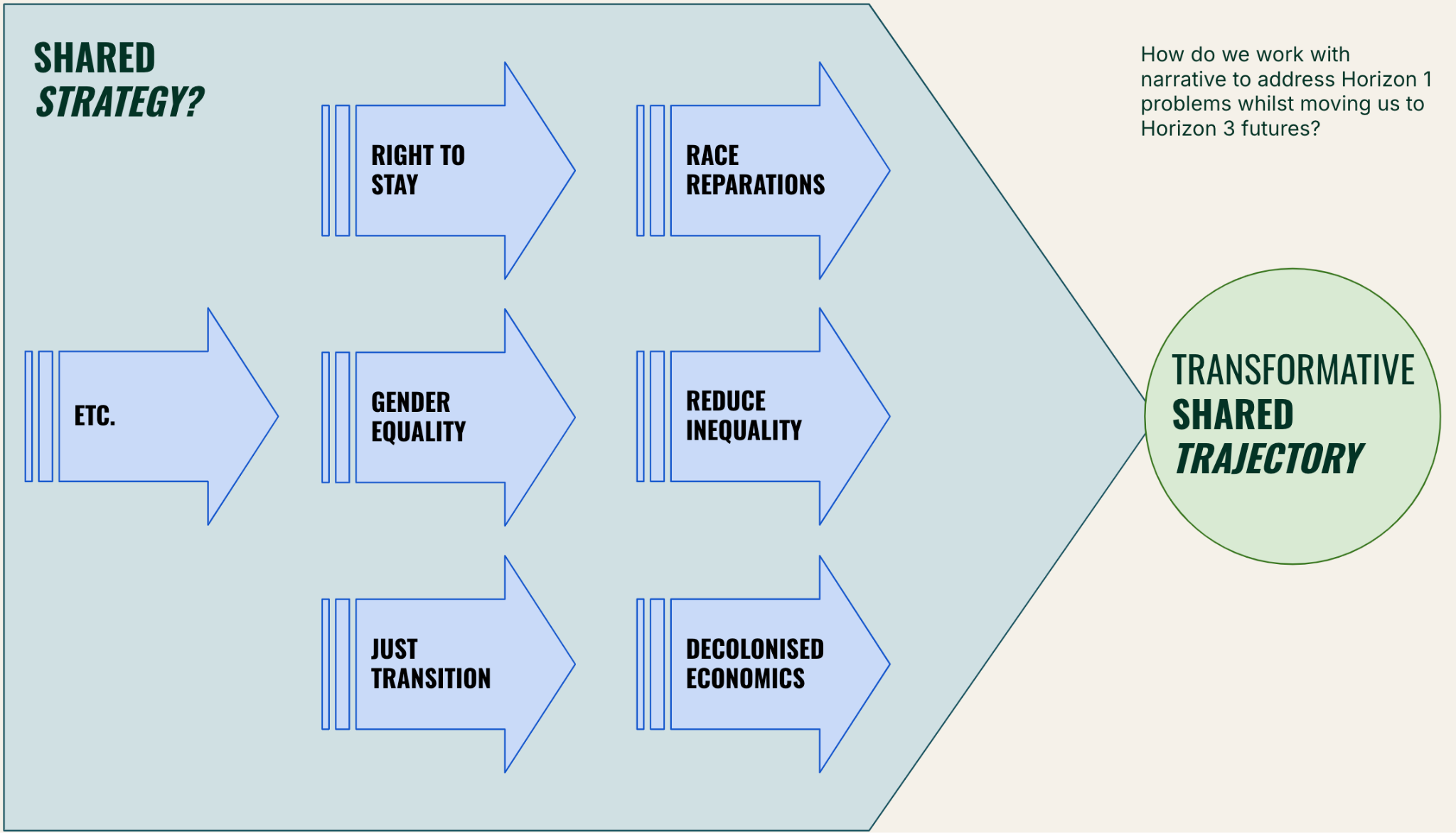
Programme Blueprint
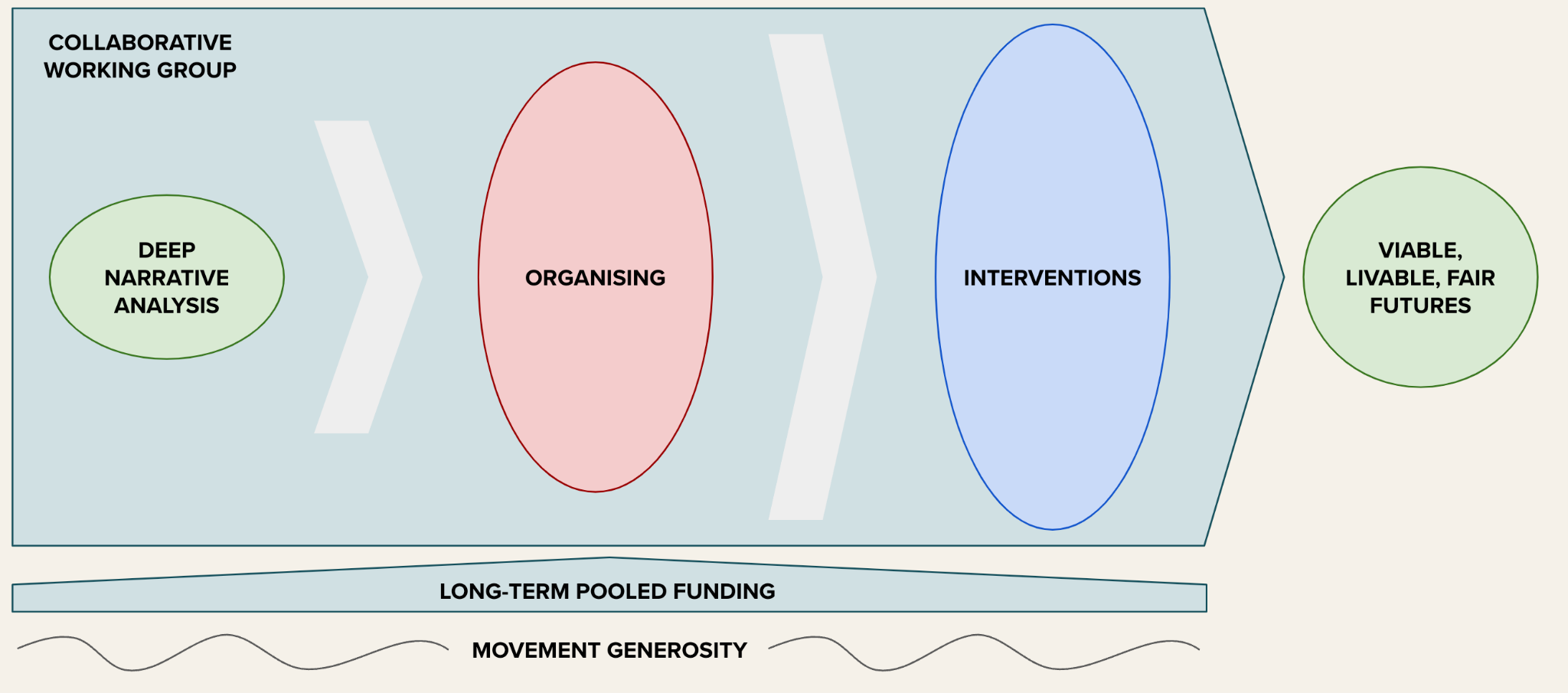
Leads
- Ella Saltmarshe, The Culture Initiative
- Paddy Loughman, The Culture Initiative
Advisors
- Ruth Taylor, Common Cause
- Suzanne Dhaliwal, GSCC
- Sarah Joynt Bowe, Healing Justice London
- Mandy Van Deven, Elemental
- James Logan, formerly Narrative Network Initiative
- Dora Meade, NEON
- Ed McGovern, Calouste-Gulbenkian
- Carrina Gaffney, Lankelly Chase
- Husna Mortuza, JRF
Step 3 · Deep Narrative Studios
Stewarded Research & Design Studios 2025, Joseph Rowntree Foundation funded
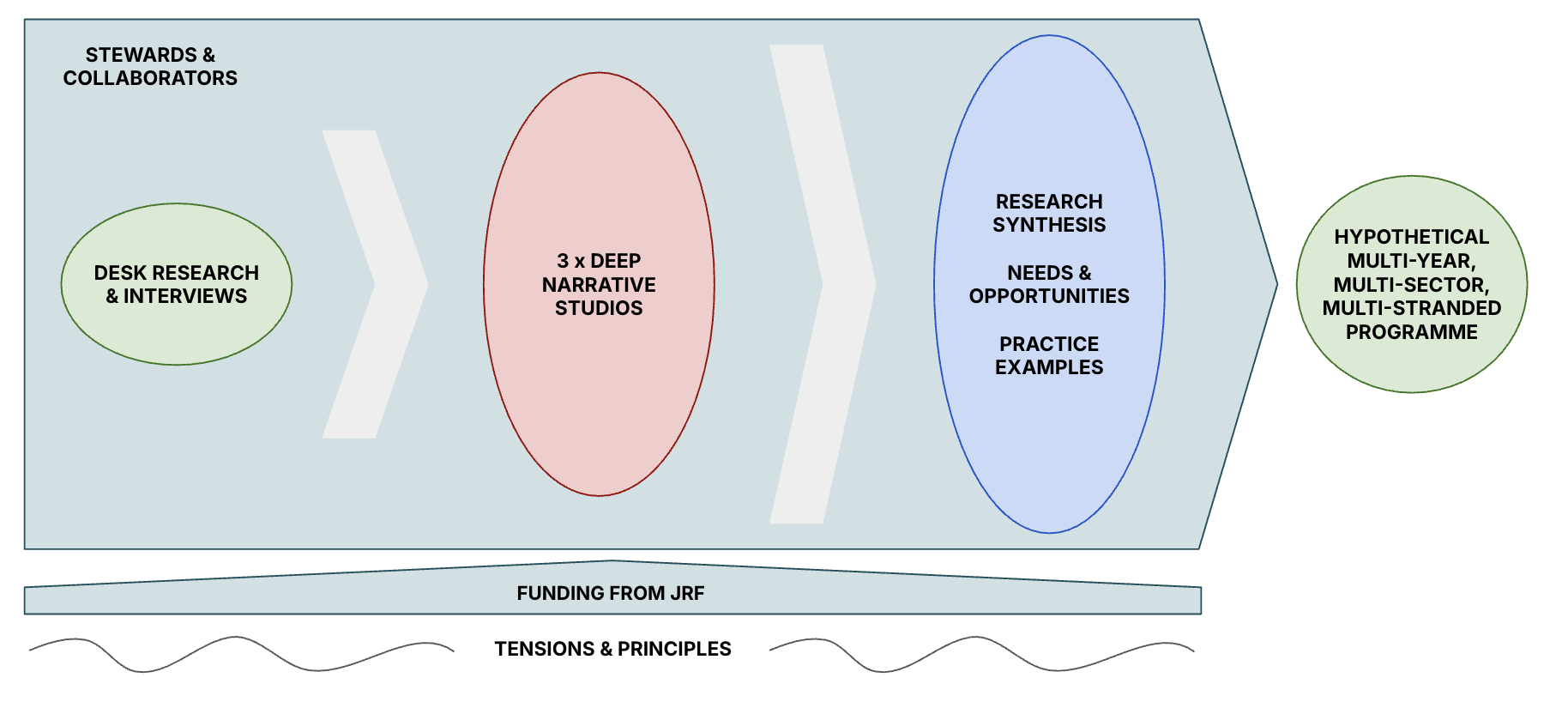
Step 3 shifted towards collective inquiry. With funding from the Joseph Rowntree Foundation’s Emerging Futures fund, a group of stewards designed and ran three Deep Narrative Studios in summer 2025 – two in person and one online – bringing together the 18 collaborators listed below. Alongside the studios, we read widely across disciplines and interviewed ten academics and practitioners.
Questions
- What do we know about deep narrative work?
- Where are the barriers / gaps / opportunities?
- What could a programme of work look like?
Approach
Step 4 · Synthesis and sharing
Sharing and refining, Joseph Rowntree Foundation funded, 2026 onwards
The current step is about making sense of what we’ve learned, sharing it, and finding out where there’s appetite to take it further, while we look for funding for a longer-term phase. So far that has meant two articles, Getting Deep, Part 1 and Getting Deep, Part 2; conversations and presentations with practitioners and funders; early research into how a longer-term programme might be held and governed; and this site.
Questions
- Who could this work be most useful to, and how do we share it with them?
- What kind of structure could hold this work over the longer term?
- Where is the real appetite for taking it further?
Stewards – Paddy Loughman, Ella Saltmarshe, Jo Ram and Ruth Taylor
Collaborators
The group of people who worked together across three ‘studio’ sessions to provide the insight and perspective that the Stewards worked from (listed alphabetically).
Interviewees
The people the Stewards spoke to for further expert insight, in particular from locations further afield than the UK (listed alphabetically).
Stewards
The team who oversaw the design, development, convening and processing of the work (listed alphabetically).
Paddy Loughman (steward, project lead) — an independent strategist and Inter-Narratives co-director. A Facing Human Wrongs alum, he previously worked with UNFCCC Climate Champions, XR, Wolff Olins, and co-authored Stories for Life.
Ella Saltmarshe (steward) — interested in creating culture that supports all life to have safe futures. Director of The Culture Initiative, which houses projects like The Long Time Project, The Long Time Academy and Inter-Narratives.
Jo Ram (steward) — has journeyed from climate activism to narratives and culture change. Currently studying the colonial past to unpick the colonial present, focussing on how environmental pollution exposes the ‘humans are separate from nature’ myth. Previously PIRC, Lankelly Chase, Platform London, and one of the Stansted 15.
Ruth Taylor (steward) — an exhausted campaigner turned independent strategist, focused on seeding new cultural ‘logics’ and narratives and strengthening latent values. Currently with Emerging Futures; previously Common Cause Foundation.
Ruth Newton (project manager)
Funding
This work has been supported by the European Climate Foundation (Steps 1 and 2), the Calouste Gulbenkian Foundation UK branch (Step 1), and the Joseph Rowntree Foundation (Steps 3 and 4).
There have been overlaps between some of the people advising or participating in this work and the organisations funding it. We think it’s important to make those relationships visible, both for transparency and because we’re interested in how our own structures and relationships participate in the cultural patterns we’ve been exploring.
Ed McGovern is at Calouste Gulbenkian, Husna Mortuza is at JRF, Carrina Gaffney is at Lankelly Chase, and steward Ruth Taylor was working with JRF’s Emerging Futures programme, JRF having funded Step 3. Lankelly Chase, JJ Charitable Trust and Civic Power Fund attended the opening workshop without going on to fund the work.
We believe questions of power, accountability and resourcing are part of any inquiry. That includes attending to where the money supporting the work has come from. The Gulbenkian endowment has its origins in an oil concession, and we name that history here as part of our commitment to examining the conditions that make this work possible.