The Three Horizons Model is a framework for structured thinking about transformation over time, developed by futurist Bill Sharpe with colleagues at the International Futures Forum, among them Anthony Hodgson, Andrew Curry and Graham Leicester. It holds three patterns of activity — three ‘horizons’ — in view at once, mapping how a present system gives way to a fundamentally different future and locating transformative work within that shift.
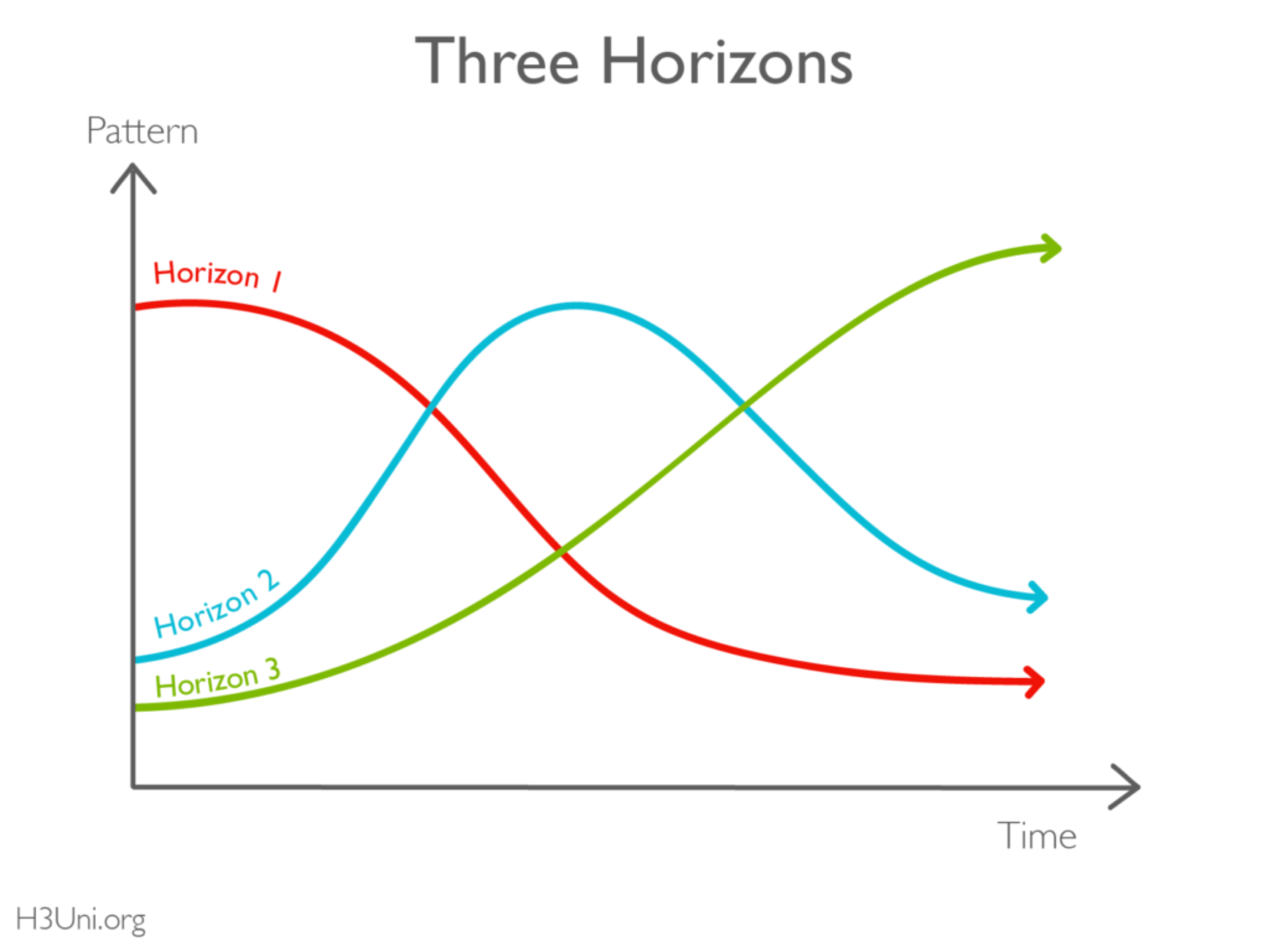 Source: h3uni.org · CC BY-SA 4.0
Horizon 1 — the dominant system
Horizon 1 is the currently dominant ‘business as usual’ system that once fit its environment but is now losing relevance and declining. It is sustained by a managerial mindset that maintains and defends what already exists.
Horizon 2 — the zone of transition
Horizon 2 is the turbulent intermediate space of innovation and entrepreneurial activity that bridges the other two. Some innovations are captured to prop up Horizon 1 (‘H2−’), extending its life; others are genuinely disruptive, opening space for a radically different system to emerge (‘H2+’). It is driven by an entrepreneurial mindset.
Horizon 3 — the emerging future
Horizon 3 is the fundamentally different, viable future — already present in seeds and pockets today — that is better aligned to a changing world. It is carried by a visionary mindset.
The three horizons are not sequential stages but coexist in the present.
Also see Berkana Two Loops, Third Attractor and Multi-level perspective